Britestream Applied: Solution for IBM WebSphere
 |
 |
 |
| |
Key Benefits
- Frees valuable server resources by offloading 100%
of SSL processing
- Tamper resistant, hardware-based solution protects
encryption keys and certificates
- Lower TCO by eliminating the need
for additional server and licensing fees
|
|
 |
|
 |
The
award-winning Britestream data privacy technology provides a secure, scalable
and simple solution for processing SSL-encrypted network traffic in applications
based on IBM WebSphere. SSL can often impose a significant performance burden
on these applications, which often means deploying more server hardware than
necessary just to implement SSL. The Britestream SSL security NIC provides
100% SSL offload while also enhancing security. This allows for a highly secure
web server or collaboration portal deployment that maximizes performance and
ultimately means optimal response time for the users. Now SSL security
can be turned on by default.
Scalable Performance and Easy Integration for WebSphere-Based Applications
 WebSphere
uses SSL encryption as the default method to secure transmissions across the
Internet. The Britestream SSL security NIC offers 100% offload for this extremely
processor intensive function, thereby improving response times to the remote
access clients. Together, Britestream and IBM offer superior SSL security and
performance, with no penalty for simply activating SSL. WebSphere
uses SSL encryption as the default method to secure transmissions across the
Internet. The Britestream SSL security NIC offers 100% offload for this extremely
processor intensive function, thereby improving response times to the remote
access clients. Together, Britestream and IBM offer superior SSL security and
performance, with no penalty for simply activating SSL.
WebSphere Applications
Commonly Needing High-Performance SSL:
- E-commerce transactions
- Remote access to secure web-based applications
- Secure collaboration portals
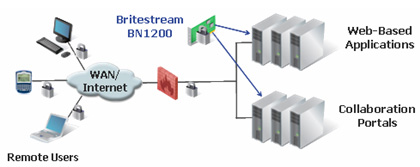
Enhanced Security
 The Britestream BN1200 SSL security NIC allows private keys and certificates
to be stored within tamper-resistant hardware. It also supports
advanced cryptographic functions by allowing the use of 1K, 2K or 4K
RSA key sizes and supporting a variety of encryption algorithms, including
AES-256. And for environments that process only secure traffic
on specific ports, the BN1200 can essentially reject traffic on any other
port, thereby preventing the host application from having to deal with
it. The Britestream BN1200 SSL security NIC allows private keys and certificates
to be stored within tamper-resistant hardware. It also supports
advanced cryptographic functions by allowing the use of 1K, 2K or 4K
RSA key sizes and supporting a variety of encryption algorithms, including
AES-256. And for environments that process only secure traffic
on specific ports, the BN1200 can essentially reject traffic on any other
port, thereby preventing the host application from having to deal with
it.
|